
PAY
TRANSPARENCY
We are the ones companies call when their pay structure starts raising questions. Those who turn directives into solutions. We don’t just talk about fairness. We demonstrate it. With data. With strategy. With impact.
Implementing the EU Pay Transparency Directive in Romania — legislative project
The European Directive requires companies to ensure transparency and equal pay for equal work.
It is a concrete step toward objective job evaluation and reducing unjustified pay gaps.
Frequently Asked Questions
Got questions? That’s to be expected. The EU Directive brings significant changes, and this section briefly answers the most common questions — whether you represent a company or are an employee. For anything else, we’re here to help.
Are you ready for the UE Directive on Pay Transparency?
Find out in a few minutes where your organisation stands. You’ll receive a detailed score for each domain — simple, clear and actionable.
Pay Transparency in Romania - Legislative context
The purpose of the law
The pay transparency law aims to ensure equal pay between women and men, for equal work or work of equal value, through the introduction of clear transparency rules.
Applies to:
- all employers (public and private)
- all workers, including civil servants
- candidates in the recruitment process
All remuneration components are included: base salary, bonuses, and benefits in kind.
Recruitment
Employers must ensure a transparent and non-discriminatory recruitment process.
Specifically:
- communicate the salary or salary range for the position
- provide relevant information from the collective labour agreement (if applicable)
- transmit this information in the job posting or before the interview
- It is prohibited to ask for the candidate’s salary history
Job postings and recruitment processes must also be gender-neutral.
Right to information
Within the organisation, employers must provide employees with access to information on how salaries are set.
They must make available:
- pay criteria
- remuneration levels
- salary progression rules
Employees have the right to request:
- their own remuneration level
- average remuneration levels, for comparable roles, broken down by gender
Response deadline: max. 30 days / 250+ employees Requests can also be made directly through workers’ representatives (trade unions)
Gender pay gap reporting
Employers with a minimum of 100 employees are required to report the pay gap between women and men.
Reporting includes:
- mean and median pay gap
- differences for bonuses and variable components
- distribution of employees across pay ranges (quartiles)
- differences by comparable job category
Frequency:
- annually (≥250 employees)
- every 3 years (100–249 employees)
Data is transmitted to: the National Agency for Equal Opportunities between Women and Men (ANES) and can be requested by ITM and CNCD.
Evaluation and correction of pay gaps
If a pay difference of at least 5% is identified in a comparable job category, it must be justified by objective criteria.
If it is not justified and not corrected:
- a joint remuneration assessment is triggered
This involves:
- detailed analysis by employee category
- comparison of remuneration levels
- identification of the causes of differences
- definition of corrective measures
The process is carried out together with workers’ representatives and must be completed through the implementation of measures within max. 6 months.
FAQ
Companies
What is the EU Directive 2023/970 on pay transparency?
It is a European regulation adopted in 2023 that requires companies to ensure wage transparency and eliminate unjustified wage differences between employees, particularly between men and women. The directive reinforces the principle of “equal pay for equal work” by requiring employers to provide information on pay levels and to report periodically on gender-based pay differences. The ultimate goal is to reduce the gender pay gap and promote fairness in the workplace.
Who must comply with the EU Directive on pay transparency?
All companies in the EU, including those in Romania, will have to comply with the new requirements starting in 2026.
The responsibilities regarding transparency in recruitment and the right to information of employees apply to all companies, regardless of the number of employees.
Transparency obligations regarding policies for setting and increasing remuneration packages within the organization apply to companies with more than 50 employees.
What does pay gap reporting mean?
Reporting involves calculating and publishing the pay differences between women and men and analyzing their causes.
a) the average pay gap between women and men;
b) the pay gap between women and men in terms of complementary or variable pay components;
c) the median pay gap between women and men;
d) the median pay gap between women and men for complementary or variable components of pay;
e) the proportion of female and male workers receiving complementary or variable components of remuneration;
f) the proportion of female and male workers in each quartile remuneration range;
g) the pay gap between women and men by worker category, broken down by regular salary or pay and complementary or variable components of remuneration.
What are the risks for a company in case of non-compliance?
Failure to comply with pay transparency obligations may result in fines and other legal sanctions, which will be “effective, proportionate, and dissuasive” according to the Directive. In addition, if a company is sued for pay discrimination and has not complied with transparency requirements, the burden of proof is reversed—that is, the employer must prove that it did not discriminate.
How does a company begin the process of complying with salary transparency?
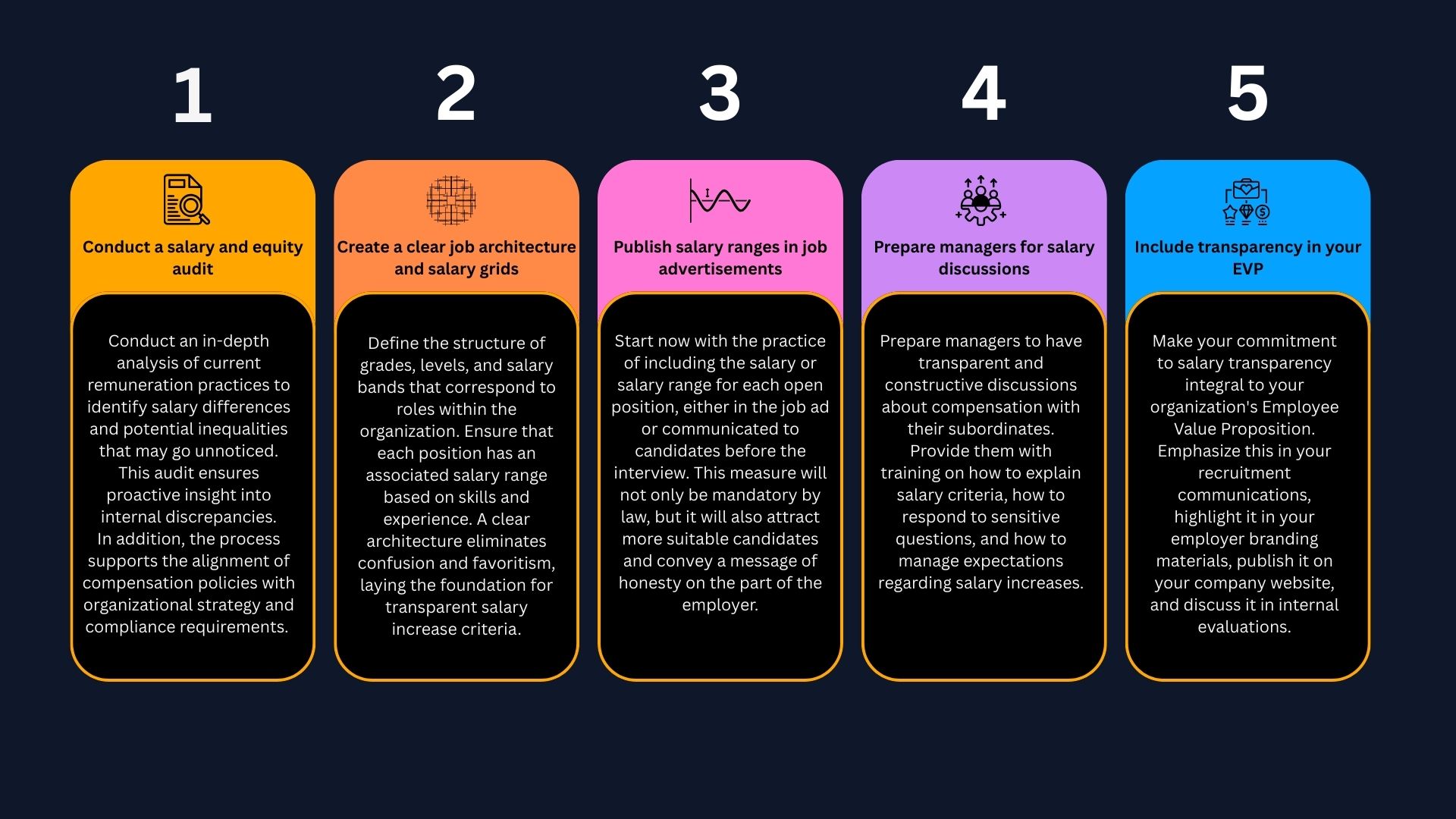
The first step is to assess the current situation. A company should conduct an internal remuneration audit – analyzing the salary scale, differences between employees with similar roles, and the criteria currently used to determine the elements of the total remuneration package (including benefits in kind).
Based on this diagnosis, clear objectives and an action plan can be established: for example, updating compensation and benefits policies so that they are aligned with the new requirements and fair internally, as well as defining an implementation schedule.
The early involvement of a dedicated team or specialized consultants can ensure that the process starts correctly and efficiently, benefiting from expertise at every step.
Primul pas este evaluarea situației actuale. O companie ar trebui să realizeze un audit intern al remunerării – să analizeze grila de salarizare, diferențele dintre angajații cu roluri similare și criteriile folosite în prezent pentru stabilirea elementelor din întreg pachetul de remunerare totală (inclusiv beneficii în natură).
Pe baza acestei diagnoze, se pot stabili obiective clare și un plan de acțiune: de exemplu, actualizarea politicilor de compensare și beneficii astfel încât acestea să fie aliniate la noile cerințe și echitabile intern, precum și definirea unui calendar de implementare.
Implicarea din timp a unei echipe dedicate sau a unor consultanți specializați poate asigura că procesul pornește corect și eficient, beneficiind de expertiză la fiecare pas.
How can we define equal work or work of equal value?
Work of equal value means work which, when compared on the basis of the same indicators and the same units of measurement with another job, reflects the use of similar professional knowledge and similar intellectual and/or physical effort, responsibilities, and working conditions. The comparison of situations can also be extended to unique sources (statistical data, market studies, etc.).
Since the text of the Directive refers to methodologies for assessing the relative value of jobs, the most appropriate option is to use a validated and objective job evaluation methodology in order to avoid any risk of error, subjectivity, or challenge on the grounds of lack of legitimacy.
What does employee category mean?
A group of employees who perform the same work or work of equal value, grouped in a non-arbitrary manner, based on non-discriminatory, objective, and gender-neutral criteria, by the employer and, where appropriate, in cooperation with employee representatives.
What constitutes objective justifications for pay differences?
From the practice of other countries where transparency regulations have been in place for several years, and especially from the interpretation of the provisions of the European Directive, we can conclude at this point that the objective reasons for the existence of pay differences can be those included and documented in each company’s Remuneration Philosophy, namely:
- Individual performance level – if all annual salary increase processes are aligned with the performance evaluation results, the same applies to any variable payment (clear indicators/KPIs, uniform bonus calculation formulas, no discretionary bonuses, etc.)
- Seniority – if the company’s philosophy includes this principle, according to which productivity increases with seniority, then successive salary increases will reflect this
- Length of service in the company
- Certain certifications/level of technical knowledge used in the respective position
How can we ensure equal pay for equal work?
Equal pay is based on the principle that employees who perform work of equal value should be paid equally. To ensure this, companies evaluate jobs based on objective and transparent criteria—for example, the skills required for the role, the level of responsibility, the effort involved, and the working conditions.
Since the text of the Directive refers to methodologies for assessing the relative value of jobs, the most appropriate option is to use a validated and objective job evaluation methodology to avoid any risk of error, subjectivity, or challenges based on lack of legitimacy.
Next, the remuneration of employees in similar or equivalent roles is compared to identify any unjustified inconsistencies. If unjustified pay differences arise, corrective measures are taken, such as salary adjustments or updating compensation policies.
A pay equity audit can be extremely helpful in this process, by highlighting areas where action is needed to ensure equal pay for equal work.
What common challenges arise in implementing pay transparency?
Many organizations face resistance to change or difficulties in adapting their internal processes. A major challenge is correcting existing pay differences—once salaries become more transparent, hidden internal discrepancies between people in similar roles or of equal value can come to light and cause tension.
Also, the lack of a clear salary structure (salary scales, defined grades or hierarchical levels, promotion criteria) and an organizational culture that is not ready for openness can make the transition difficult.
Last but not least, management must be prepared to communicate openly and consistently—poorly managed transparency (e.g., inconsistent communication of salary data) can create confusion or dissatisfaction among employees.
What is the role of the HR department and managers in ensuring salary transparency?
Both the Human Resources department and line managers have crucial roles in the successful implementation of salary transparency.
HR is responsible for developing and updating salary policies, regularly analyzing salary data, and ensuring compliance with the legal framework. HR must also provide training and support to managers and facilitate communication—in practice, creating a common language within the organization about salary criteria and principles of fairness.
Managers, in turn, have a duty to apply these policies in their teams and to be transparent in their compensation decisions: they must explain to their subordinates how salaries are set, what expectations exist for salary increases or promotions, and ensure that compensation decisions are fair and well communicated.
Essentially, HR provides the framework and rules, and managers put them into practice on a daily basis—close collaboration between these two parties ensures consistency and trust in the company’s salary policy.
Who should ultimately be responsible for salary transparency: HR, legal, finance, or executive management?
Salary transparency cannot be the responsibility of a single department. It is a joint effort that only works when roles are clearly defined.
HR plays the leading role in design and implementation: role structure, salary scales, and communication to employees. The legal department is responsible for interpreting legal requirements, managing risks, and providing legal support for decisions. The finance function validates the impact on the budget and the accuracy of the data.
Executive management is the main pillar in supporting the approach, setting the level of acceptable risk, and making final decisions when compromises arise. Without clear commitment at this level, salary transparency initiatives tend to stagnate or become uneven. However, the implementation of new salary transparency practices is definitely not an HR or legal and compliance project, but rather a strategic business project with profound consequences in changing organizational culture.
How can managers be prepared to respond clearly and credibly to the question: "Why is there this pay gap?"
Managers need to understand both the data and the logic behind salary decisions. This means familiarizing themselves with the results of role assessments, salary grid positioning, performance, market data, and any past decisions that influence current salary levels.
The organization should provide them with standardized explanations, questions, and clear answers, as well as well-defined escalation paths, so that messages are consistent across all teams.
It is important that this information be reviewed periodically as roles, data, and the legal framework change.
Companies
How is the success of pay transparency measured?
Success is assessed through a combination of quantitative and qualitative indicators. These include:
- a reduction in unexplained pay gaps,
- a decrease in the number of corrective adjustments from one year to the next,
- a decrease in complaints or disputes related to pay, and
- improved results in internal surveys on perceptions of fairness and trust.
The level of preparedness for controls and audit results are also important benchmarks.
How do we differentiate between structural issues and isolated individual situations?
Structural issues appear as recurring patterns in similar roles or levels and are usually caused by job structure, market positioning, or historical salary practices.
Individual situations are one-off cases, generated by specific circumstances such as role changes, retention measures, or data errors.
Structural problems require systemic solutions, such as adjusting pay scales or evaluation criteria, while individual situations must be corrected on a case-by-case basis and monitored afterwards.
How do we prevent short-term solutions from creating salary differences again over time?
One-off adjustments must always be accompanied by an analysis of the real causes. Organizations should track these adjustments, review recruitment and promotion practices, and apply control mechanisms such as clear pay-band placement limits or approval thresholds. Regular pay equity analyses help prevent new disparities from arising in future decisions.
How often should role evaluations, pay scales, and analyses be reviewed?
Role evaluations should be reviewed whenever a role changes significantly and, in any case, periodically as part of a broader review of the organizational structure. Pay scales are typically updated annually to reflect market developments. Pay equity analyses should be conducted at least once a year and before important events such as salary increases or reorganizations.
What level of documentation is appropriate in order to support employee classification?
The documentation should clearly describe the purpose of the role, the responsibilities, required competencies, decision-making level, and working conditions. It must also explain how roles were evaluated and assigned to a specific category or level (a summary of the factor definitions within the applied evaluation methodology).
The information should be detailed enough to demonstrate the objectivity of decisions, but also practical enough to be easily updated.
How much context should be provided to employees?
Employees should receive sufficient information to understand how their salary is determined, what factors can cause differences, and what options they have for advancement. This typically includes Job Architecture, Compensation and Benefits Policy with all principles and mechanisms for awarding, calculating, and progressing, Criteria for career and/or salary band progression, principles for setting salary ranges, performance evaluation criteria, and positioning relative to the average of comparable colleagues.
Detailed individual comparisons or confidential information should not be disclosed.
What is the role of managers in pay transparency?
Managers are the main drivers of the dialogue on remuneration. Their role is to explain remuneration decisions, clarify how salary grids, pay rise processes, promotion or lateral transfer processes, variable bonuses and benefits work, and answer questions accurately and consistently. To do this effectively, managers need to be trained, have clear guidelines, and be supported by HR in sensitive or complex situations.
How should collaboration with unions and employee representatives be managed?
Dialogue should start early and be ongoing. Organizations should share the methodology, timeline, and aggregate results and involve unions or employee representatives in discussions about role assessment and implementation.
Transparent collaboration helps build trust and reduces the risk of conflict or delays.
How does pay transparency align with data protection requirements?
Salary transparency is based on detailed analyses of pay differences, but these must be communicated carefully.
Employers should present information at an aggregate level, explaining the causes of differences, in order to comply with transparency requirements without compromising individual confidentiality, in accordance with data protection legislation.
How can the balance between transparency and confidentiality be maintained in small groups?
In small groups, it is recommended to use broader categories, salary ranges, or narrative explanations instead of exact values.
When there is a risk of identifying individuals, these approaches allow transparency principles to be respected without violating confidentiality.
If larger groups/categories are not relevant or applicable, then the only ones who can have access to the information are employee representatives or authorities.
How are jobs evaluated in a level-based evaluation system?
Jobs are evaluated based on objective and gender-neutral criteria such as skills, effort, responsibility, and working conditions. Most validated job evaluation methodologies contain precisely this type of criteria for evaluating the relative value of jobs, in a clear system based on scores for each combination of applicable factors.
These standards are applied consistently in order to determine the relative value of work, in accordance with the principles of equal pay for work of equal value.
Can blue-collar and white-collar jobs be compared?
Jobs can be considered comparable if they are evaluated using the same objective framework and if they demonstrate equivalent value on the established criteria.
Differences in collective bargaining agreements or employment conditions do not automatically preclude comparability, but must be carefully analyzed and documented.
In cases where blue-collar jobs are evaluated according to certain factors and support or management roles according to other criteria, experts recommend unifying evaluation methodologies and applying the same type of criteria to absolutely all positions in the organization.
What does it mean when the analysis shows that men are paid less than women?
In certain roles or comparison groups, the salary analysis may show that men earn, on average, lower salaries than women. This result does not automatically indicate a fairness issue, but it does require the same level of analysis and explanation as any other pay difference.
Employers need to check whether the difference is explained by objective factors such as role level, experience, performance, or work schedule.
When differences are justified, they must be documented and explained transparently, in exactly the same way as differences that disadvantage women.
If unexplained differences remain, adjustments are necessary to ensure fair treatment for all employees.
Employees
Is my employer required to include salaries in job advertisements?
No, starting in 2026, companies will instead have to disclose the salary range (minimum value – maximum value) for vacant positions, either directly in the job advertisement or at the latest before the first job interview.
What salary information can I request from my employer?
You can request the criteria used to determine your remuneration package, as well as average salary levels for similar roles held by male and female colleagues, without disclosing the personal data of your colleagues.
Can I find out how much my colleagues earn?
Not by name. The directive allows access to average values for equivalent or equal value positions, not to individual salaries.
Employees
Am I protected if I ask about salary or salary differences?
Yes, failure to comply with salary transparency obligations can result in substantial fines and other legal sanctions, which will be “effective, proportionate, and dissuasive” according to the Directive. In addition, if a company is sued for salary discrimination and has not complied with transparency, the burden of proof is reversed—that is, the employer must prove that they did not discriminate.
How will pay transparency affect me as an employee?
On the positive side, salary transparency gives you more clarity and confidence. You will know where you stand in terms of salary within your company and what you need to do to advance (if policies are transparent, the criteria for promotion and raises become clear).
You will also have the certainty that other colleagues in similar positions are paid comparably, thus eliminating uncertainties that can cause frustration. In the long term, transparency can lead to the gradual closure of any gender pay gaps and other disparities, ensuring that all employees are treated fairly. For you, this means a fairer working environment and the feeling that your salary truly reflects your contribution and skills.
Additionally, if you change jobs, the fact that the salary range is displayed in the job ads will help you choose offers that match your expectations, saving time and reducing the chances of being underpaid.
Does my last salary matter when negotiating the salary for a new job?
No. As of June 2026, inquiries regarding an applicant’s previous salary will be prohibited. Negotiations will be conducted strictly within the minimum and maximum pay ranges disclosed for the position, based on the candidate’s level of expertise, relevant experience, and required technical competencies.
More questions?
For more answers, we encourage you to open a dialogue with your manager or the human resources department in your organization.
Quick Implementation Guide
How can Cteam help
01.
We Analyze
Pay audit and equity assessment
We conduct an in-depth analysis of your company’s current compensation practices to identify potential pay gaps or inequities.
Through this initial pay audit, Cteam delivers a clear picture of the current situation, highlights risk areas (such as unjustified gender pay gaps), and provides recommendations on how discrepancies can be corrected.
02.
We Define
Reviewing pay transparency policies
We support the creation and implementation of internal policies that ensure transparency and fairness in pay.
Cteam provides step-by-step consulting in defining clear rules for base salary, bonuses, and benefits, so that every employee understands how their pay is determined and which criteria (competencies, performance, tenure, etc.) influence salary progression.
The result: a transparent pay regulation, clearly communicated across the entire organization.
03.
We Compare
Benchmarking and advanced market analysis
We provide up-to-date insights into market pay standards, by industry, to ensure your compensation packages are both internally equitable and externally competitive.
By comparing your data with market benchmarks (salary benchmarking), we help align pay levels with economic realities, eliminating situations where roles are overpaid or underpaid compared to the market average.
04.
We Build
Implementing an equitable pay structure
We support the definition of a clear job architecture and salary bands based on pay levels and benchmarks. This involves establishing role categories, hierarchy levels, and associated pay ranges, grounded in competencies and responsibilities.
A well-defined structure removes ambiguity and ensures consistency in how employees in similar roles are paid.
05.
We Communicate
Training for managers and HR
We organize workshops and training sessions for HR teams, HR Business Partners, and managers, covering both the legal aspects of pay transparency and practical communication strategies and discussion management techniques around compensation.
The goal is to ensure managers are well prepared to explain the “why” behind pay decisions and to hold open, informed conversations with their teams about compensation.
We also deliver awareness programs for all employees, informing them of their rights and the benefits of pay transparency—so the entire organization understands and supports the process.
06.
We Support
Action plans and ongoing support
Every company has different needs, which is why Cteam develops action plans tailored to organizational culture and the issues identified.
We support clients in implementing concrete measures—from updating policies to setting up reporting systems—and provide long-term support.
This ongoing support includes periodic consulting to adjust policies as the organization evolves or as market conditions change, monitoring progress through specific indicators, and assisting with the preparation of mandatory reports.
In practice, we become a trusted partner throughout the company’s transition toward pay transparency.
Do you need help implementing salary transparency?
Cteam offers comprehensive consulting services in compliance with the EU Directive: from salary audits and fair salary grids to training and internal communication.